
Regulation (EC) No 1935/2004 on EUR-Lex covers materials and articles intended to come into contact with food. Product-specific applicability and supporting documents must be reviewed for the destination market.
Quality Planning
Define the construction, surface and validation plan before production.
The supplied product catalogs include carbon-steel and aluminum programs, common thicknesses from 0.4 mm to 0.8 mm, and multiple nonstick and decorative coating families.
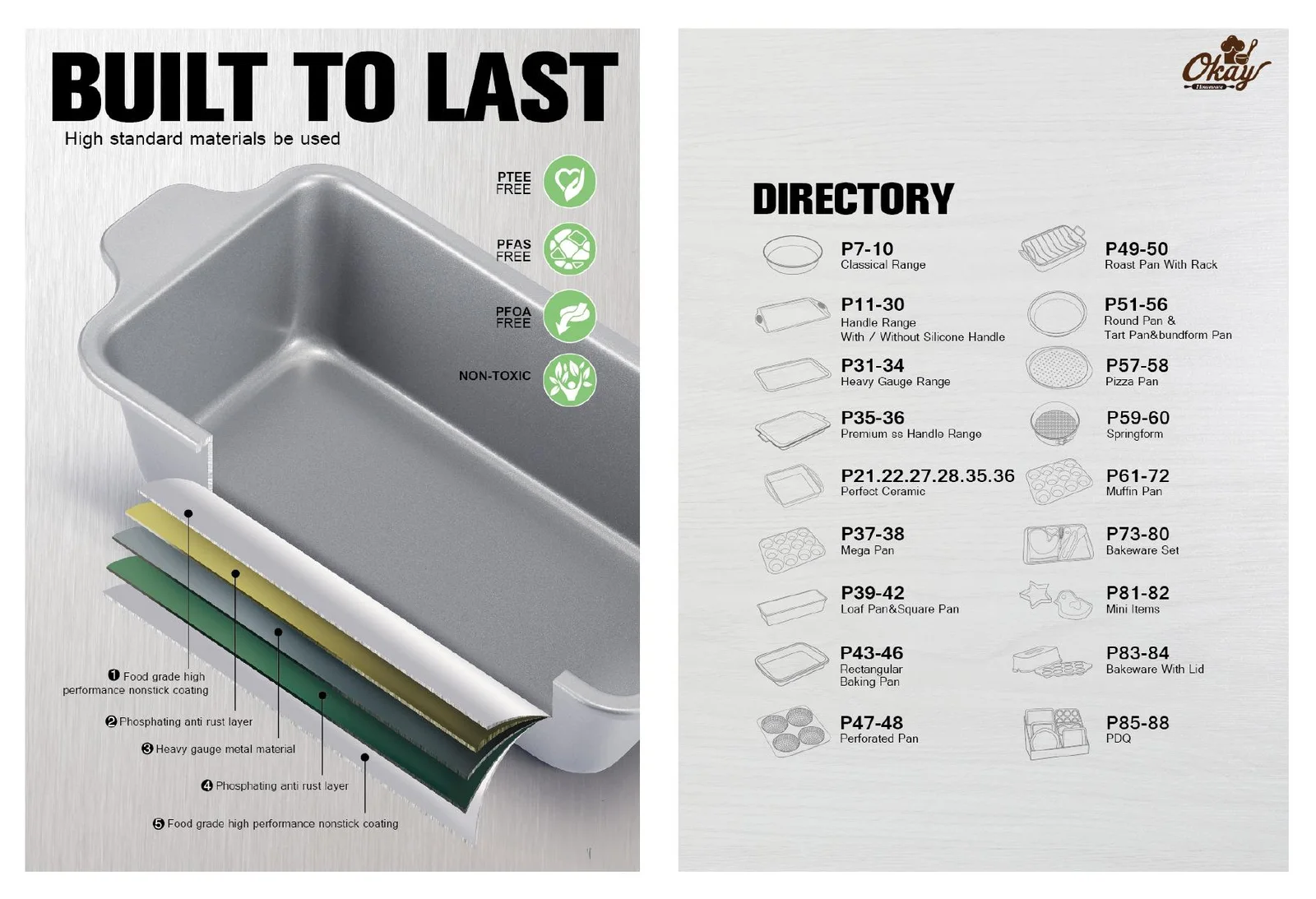
Material Structure
Performance begins below the surface.
A bakeware specification should define the substrate, metal thickness, forming structure, pretreatment and coating system together. Changing only the visible color does not define the complete product.
- ✓Substrate selection
Carbon steel and aluminum are available across different product families. - ✓Thickness planning
Catalog families include 0.4, 0.6, 0.7 and 0.8 mm constructions. - ✓Coating selection
Classic nonstick, color, ceramic-style, speckled, copper and metallic finishes.
Coating Families
Choose by appearance, use case and target market.
Final coating chemistry and test documentation must be validated against the selected manufacturing program.
Classic nonstick
Dark, neutral finishes for broad retail and everyday bakeware lines.
Bright color
External and internal color combinations designed for differentiated shelf impact.
Ceramic style
Light, copper and color ceramic-style visual programs across selected constructions.
Speckled & metallic
Black speckles, marble effects, golden and champagne finishes for premium collections.
Quality Checklist
Confirm what will be inspected.
Dimensional checks
Length, width, height, wall profile, cavity geometry, flatness and latch fit where applicable.
Appearance checks
Color consistency, coating coverage, scratches, dust, dents, deformation and logo position.
Packaging checks
Barcode, artwork, label position, inner protection, carton marks and packing quantity.
Product catalogs mention standards and systems including ISO, BSCI, LFGB, DGCCRF, FDA-related testing and PFOA-free coating claims. These cannot be treated as universal LINHAO certificates. Availability and scope must be confirmed for the chosen product, factory, coating and order.
Authoritative References
Start compliance planning from official sources.
These links provide regulatory context. They are not proof that every LINHAO product or coating is certified for every market.
Commission Regulation (EC) No 2023/2006 on EUR-Lex addresses good manufacturing practice for food-contact materials and articles.
21 CFR 175.300 on eCFR is a U.S. regulatory reference for resinous and polymeric coatings. The selected coating system and intended conditions of use require project-specific review.
Ask for documents that match the exact product, substrate, coating, color, production route and order. A regulation link, catalog statement or unrelated report is not a substitute for project-specific evidence.
Quality requirement
Tell us the destination market before sampling.
This allows the material, coating and documentation plan to be aligned from the beginning.